
Sexual harassment at work
Sexual harassment is prohibited by Finnish law. It can take the form of sexually suggestive gestures, vulgar comments, or unwanted physical touch. Learn to recognise sexual harassment and how to report it to your employer. By law, the employer must investigate all reports of sexual harassment at the workplace.
On this page
What is sexual harassment?
Sexual harassment is unwanted sexual behaviour that violates a person’s mental or physical boundaries. Harassment can also happen through digital channels or technology.
Sexual harassment can include, for example:
- Sexually suggestive gestures or facial expressions,
- vulgar comments and jokes,
- comments about someone’s body, dress or private life,
- physical touch, or
- the display of inappropriate materials.
Sexual harassment is prohibited by Finnish law. However, it can be difficult to address because the victim may not want to report it or is too afraid to do so. Employers may also lack clear instructions or the knowledge needed to deal with sexual harassment.
Employer’s responsibility: Inappropriate behaviour must be stopped
The employer is responsible for all employees’ health and safety at work. According to the Occupational Safety and Health Act, the employer must act if an employee experiences inappropriate behaviour, including behaviour by a patient or a client. Sexual harassment must never be normalised as part of the patients’ illness or the nature of the work.
Management must clearly state that inappropriate behaviour is not accepted in the workplace. The workplace should have clear, jointly agreed rules for respectful behaviour. The procedures and instructions for reporting sexual harassment must be clear, and all employees must be aware of them.
What to do if you experience sexual harassment at work?
- Raise the issue if you feel safe doing so. Tell the harasser that you find their behaviour inappropriate and ask them to stop.
- If the situation feels difficult, ask an occupational health and safety officer, a shop steward or another named workplace safety person to help you.
- Write down when and where the incident happened, what happened and who was present.
- Keep all evidence of the incident, such as messages, call records, photographs or videos.
- Always report inappropriate behaviour to your employer. Contact your own manager or the manager of the harasser. If your manager is the one responsible for the inappropriate behaviour, contact your manager’s boss. Ask what action will be taken. By law, the employer must act after becoming aware of the incident.
- If the employer does not act, or the action does not help, contact the occupational health care provider, the occupational safety representative or the shop steward.
- You can also seek advice from the Finnish Supervisory Agency (a government authority responsible for workplace supervision and enforcement) or the Ombudsman for Equality.
- If you think a crime may have taken place, contact the police. Even if you feel unsure, you can reach out to the police. They can help you determine whether a criminal complaint should be filed.
How to report sexual harassment at work?
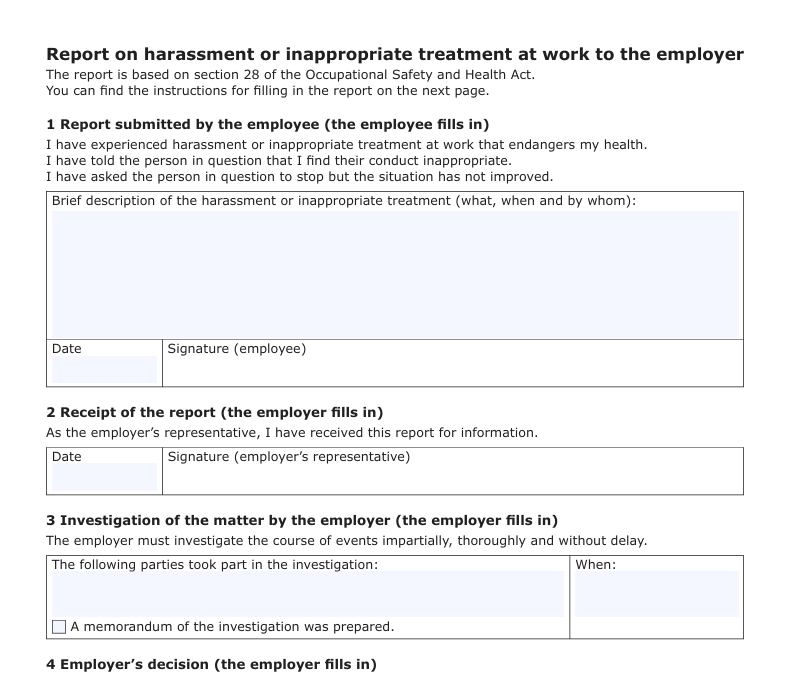
If you have experienced inappropriate behaviour at work, you can use a printable form in English provided by tyosuojelu.fi, the website of the Finnish Occupational Safety and Health Administration, to report it to your employer.
Instructions
- In the first section describe how, when and by whom the harassment occurred.
- In section 2, the employer confirms that the report has been received.
- In section 3, the employer writes how and when the matter has been investigated.
- In section 4, the employer writes their conclusion of the investigation and what will be done about it.
- In the last section, both the employer and employee confirm that have received the filled form.
You can find detailed instructions for filling in the report on the second page of the form.
SuPer’s member survey on sexual harassment
In spring 2026, SuPer asked its members working in social care, healthcare and early childhood education about their experiences of sexual harassment in the workplace. The results suggest that sexual harassment is common in workplaces where SuPer members work, and typically the harasser was a patient or a client. More than half (57%) of the respondents had experienced sexual harassment at work during the previous five years.
Read more about the survey results (in Finnish)
Commitment to safer workplaces
The Finnish Ministry of Social Affairs and Health has published a report on workplace practices for preventing workplace sexual harassment. Based on the report, SuPer with other labour market organisations has made a joint commitment to address workplace sexual harassment and provide clearer guidance.